


- Financial Insights
- Market Insights
The Bond Markets Get Real
Gary Dugan, Michael Chu and Bill O'Neill
The Global CIO Office
- Long term bond yields in US and Japan showing persistence
- The Fed will likely cut rates but the market has its longer term concerns
- Debt, persistence of inflation and changing leadership at the Fed will keep the pressure on
- The BoJ, likely on a rate hiking path will add to the upward pressure on long term yields globally
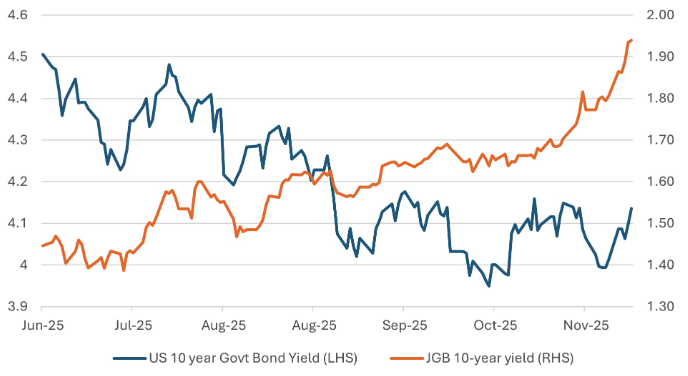
The sharp rise in US and Japanese bond yields last week is another sign of tougher times ahead for bond markets. The week saw US 10-year treasury yields surge 12 basis points (bps) to 4.14%, the highest since April. In Japan, the two-year yields rose above 1.0%, a level not seen since 2008.
Our short duration call on the US bond market has garnered greater support. In the short term, we sense a repricing of the ‘real’ issues in bond markets: real interest rates, persistent inflation, sovereign debt stress, and the re-politicisation of central banking. We believe the global fixed-income complex is being repriced along four axes, each of them structural, not cyclical, and each further fuelling the debate about the direction and credibility of central bank policy.
Chart 1: US and Japanese 10-year Bond Yields on the Rise
%
Source: Bloomberg
First, the persistence of higher inflation in the United States and, increasingly, in Japan, is leading to inflation expectations being reset. While the US core PCE data for September, the latest available, showed a modest deceleration, the figure, at 2.8%, still remains well above the Fed’s comfort zone. More importantly, real rates have begun to rise, not because the Fed is aggressively tightening, but because bond investors are starting to demand a greater real return amid chronic fiscal expansion, geopolitical fragmentation, and supply-side inefficiencies.
Second, Japan’s bond market is experiencing a profound shift. Bank of Japan Governor Kazuo Ueda has signalled a willingness to exit the negative interest rate policy and abandon remnants of yield curve control. This, along with rising wages and consumer prices, and expansionary fiscal policies, is pulling Japanese bond yields higher. Yield on the 10-year Japanese Government Bond (JGB) recently breached 1.85% and is approaching 2%, levels unseen in more than a decade. For global investors, this is immensely significant: the Japanese yen was the funding leg in a host of carry trades, particularly into US Treasuries and global credit. As Japanese yields normalise, that capital is being repatriated or reallocated, placing upward pressure on global real yields.
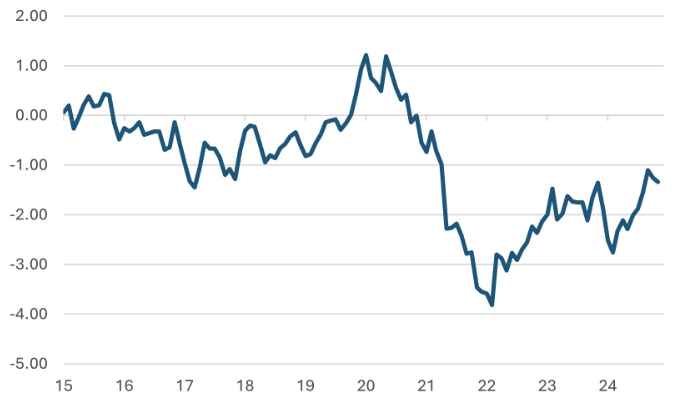
Chart 2: JGB 10-year Real Yield
Source: Bloomberg
Third, and perhaps most fundamentally, markets are repricing the risk premium attached to sovereign debt, particularly in economies with high and rising debt-to-GDP ratios. This is not merely a matter of nominal supply of debt; it reflects a deeper concern about the sustainability of fiscal policy in a world experiencing structurally slower growth. As the US approaches sovereign debt levels exceeding 120% of GDP, investors are increasingly pricing in a term premium to account for not only default risk (which remains remote) but inflation risk, refinancing risk, and policy risk as well. These concerns are further exacerbated by rising deficits in a US mid-term election year, which may signal more expansionary fiscal policy irrespective of monetary prudence.
Fourth, the looming possibility that Kevin Hassett, currently the Director of the National Economic Council, may succeed Jerome Powell in 2026 introduces a new and deeply political risk. Unlike Powell, Hassett is widely viewed as favouring aggressive monetary easing and has publicly called for early and deeper rate cuts, even in the face of persistent inflation. His perceived willingness to tolerate structurally higher inflation represents not merely a cyclical shift from what the Fed currently stands for, but also a fundamental break from decades of central bank orthodoxy. In effect, this would be an experiment with a new way of understanding inflation risk, one that downplays price stability in favour of growth and labour market metrics.
For bond markets, this represents a serious upside risk to long-term real yields. If investors come to believe that a Hassett-led Fed would pursue a looser inflation regime guided by political objectives, the inflation risk premium embedded in long-term bonds will rise accordingly, compounding the repricing already underway. Such a pivot risks bringing heightened volatility, deeper uncertainty about monetary policy credibility, and a loss of cohesion within the Fed itself.
This also raises the broader concern about the Fed’s institutional integrity. As we’ve seen recently with the FDA and other US agencies, differences between the political leadership and institutions can spark internal dissent and reputational erosion. In this context, it is not inconceivable that Hassett’s appointment could trigger resignations from senior Fed officials, particularly if a more overtly political or doctrinaire policy stance begins to undermine the Fed’s credibility and cohesion. That would further deepen the market’s perception of risk and would be priced into term premia accordingly.
Recent academic literature offers strong support for the idea that high sovereign debt levels can raise long-term real interest rates. A 2024 Federal Reserve paper, “Government Debt, Limited Foresight, and Longer-Term Interest Rates,” argues that with bounded rationality and imperfect foresight, markets fail to fully internalise the future tax implications of public debt until a tipping point is reached. At that moment, long-term yields adjust upward abruptly.
Similarly, the Dallas Fed’s updated study, “Revisiting the Interest Rate Effects of Federal Debt” (2025), concludes that for every 10-percentage-point increase in the debt-to-GDP ratio, long-term interest rates rise by 20–25 bps. That linkage becomes stronger when debt accumulation is not matched by credible primary surplus trajectories. An earlier multi-country study (2016) by the IMF supports these findings, showing a positive correlation between high public debt and long-term bond yields across 19 advanced economies.
Other studies go further: a recent working paper from 2024 explores how government backstopping of idiosyncratic risk, via social insurance and fiscal transfers, can itself be inflationary in the long run by suppressing precautionary savings and raising consumption volatility. This dynamic is especially significant in the US, where fiscal dominance narratives are beginning to re-emerge.
Taken together, the academic consensus is clear: there is no free lunch from rising debt. Eventually, long-term real rates must rise to compensate investors for the rising risks inherent in sovereign balance sheets.
Fed and BOJ: A Tale of Two Divergences
Given this backdrop, attention turns to the upcoming central bank meetings. The Fed is expected to cut rates when it meets on Wednesday, with market-implied odds pointing to a 25 bp cut. While inflation data have moderated, they remain above the Fed’s target, and the broader financial conditions index has already loosened considerably since October. Yet, the Fed seems inclined to deliver the cut, partially as a hedge against a weaker labour market and the impact of rising bond yields.
In contrast, the Bank of Japan is just starting out. Its 18-19 December meeting could see the first rate hike in years as the central bank confronts sticky price and wage inflation. With inflation holding above 2% and policy normalisation now squarely on the table, the yen has strengthened and JGB yields have surged. To add to the conviction that a rate rise could be imminent, media reports suggest that the government is not opposed to a rate hike. This divergence – a dovish Fed versus a hawkish BOJ – represents a sharp reversal of the policy landscape that characterised the past decade. It is also triggering the unwind of cross-border trades that once helped suppress global long-term rates.
Looking Forward
The outlook for early 2026 is now being defined by those expecting a benign monetary easing cycle and those who believe the bond market will impose limits on central banks. If real rates continue to rise, due to debt risk, inflation persistence, policy transition uncertainty, or monetary divergence, central banks may not find it easy to cut rates further.
In that world, the cost of capital will stay structurally higher, volatility will rise, and capital allocation will require a sharper focus on risk-adjusted returns. For now, the bond market is doing the real work, forcing both investors and policymakers to reckon with a world where duration risk is no longer benign. The next stage is an investor focus on potential capital losses in long term bonds.
Our strategy is to be short-duration in the US Treasury market while seeking returns from actively managed strategic bond funds that can profit from the market volatility. We are probably minded to move closer to neutral in high yield, although rate cuts will do no harm to credit risk.